· 3 min read
Inside cintel: The Patent and IP Landscape
The Patents module of cintel's luxury-resale deployment: ten tracked entries covering authentication patents, design patents, trademarks, trade dress, and blockchain provenance — each with assignee, filing office, legal area, and threat level. Read from the running system.
cintel is RRECKTEK’s competitive-intelligence platform. Inside cintel: Competitive Intelligence for the Luxury Resale Market walked the deployment’s main views — the dashboard, the signal feed, the capability matrix, and the positioning map — and listed the remaining modules in the workspace. This page covers one of them: Patents. Every figure below is read from the running system.
What the module tracks
The patents table holds ten entries. Each carries an assignee, a filing office, a grant date where one exists, a legal area, a status, a threat level (critical / high / medium), and a confidence score. The entries divide across five legal areas: authentication (3), design patent (3), trademark (2), trade dress (1), and provenance (1).
The table is deliberate about what is and is not a utility patent. Trademark and trade-dress entries carry no patent number — they are recorded as registrations or protected designs, not inventions.
Authentication patents
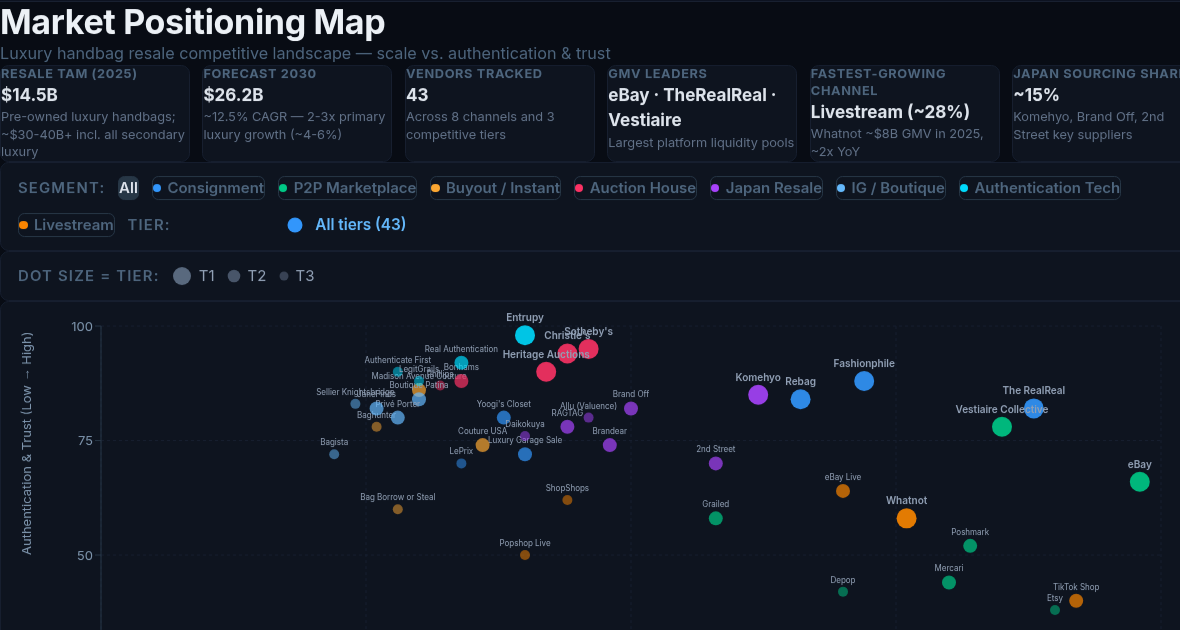
The three authentication entries are the utility patents behind machine-assisted counterfeit detection — the technology segment the positioning map places at Entrupy and Real Authentication:
- Entrupy — WO2015157526A1 (WIPO/PCT, published 2015-10-15; priority 2014-04-09; inventor Vidyuth Srinivasan). Authenticating physical objects using machine learning from microscopic variations — microscopy plus machine learning on microstructural variations; the foundational family behind the Entrupy device. Threat level: critical.
- Fashionphile — US11501320B2 (USPTO, granted 2022-11-15; inventors Ben Hemminger and Sarah Davis). A portable device with a 10x–50x lens captures fabric microstructure — stitching, creases, grain — and a bilinear CNN with dual feature extractors classifies authentic versus counterfeit. Threat level: high.
- Fashionphile — US11763323B2 (USPTO, granted 2023-09-19; same inventors). The continuation: smartphone plus lens-accessory magnified fabric images analyzed by a bilinear CNN, with 98–100% accuracy recorded across luxury fabrics. Threat level: high.
Brand-side design rights
Three design patents cover the shapes of the bags themselves:
- Hermès — USD656313S1 (2012-03-27): the ornamental design of the Birkin handbag.
- Louis Vuitton — USD1039271S1 (filed 2021, granted 2024-08-20) and USD1023562S1 (filed 2020, granted 2024-04-23): two handbag ornamental designs.
Trademark, trade dress, and provenance
The remaining entries record brand-side protection that shapes what a reseller may do:
- Hermès — Birkin / Kelly trade dress. The silhouettes are protected via design rights and trade dress, enforced in Hermès v. Rothschild (MetaBirkins NFTs, SDNY, February 2023): the jury found trademark infringement, dilution, and cybersquatting, awarded Hermès $133,000, and the First Amendment did not bar liability — NFTs were treated as commercial goods. The signal feed on the dashboard carries the same decision as a COURT DECISION entry.
- Louis Vuitton — Toile Monogram trademark and trade dress. The Monogram canvas and Damier pattern are protected as registered trademarks and trade dress — the basis for anti-counterfeit enforcement rather than utility patents.
- Bottega Veneta — USPTO Reg. 4527371. Trademark protection for the intrecciato woven-leather pattern as a source identifier.
- AURA Blockchain Consortium (LVMH-led, with Prada and Richemont, 2021): on-chain product traceability and provenance, recorded under the provenance legal area for its bearing on resale authentication and anti-counterfeiting.
What the landscape shows
All ten entries are marked active. Confidence scores run from 65 (AURA) to 95 (the two Fashionphile patents). The only utility patents in the table belong to the authentication-technology side of the market — Entrupy and Fashionphile — while the brands protect the goods themselves through design patents, trademarks, and trade dress, and enforce them in court. The system stores both, labeled as what they are.