· rreck · data · 5 min read
The Search for EULA Eve
Population genetics has Mitochondrial Eve: the ancestor every living human's mitochondrial DNA traces back to. Fine print has an equivalent question. Legal text is almost never written fresh — it descends. This is a technical orientation on measuring that relatedness: content hashes for identity, winnowing fingerprints for inherited wording, on-prem SLM embeddings for kinship of meaning, and a dated derivation graph for descent — across 6,738 documents and 125,295 clauses. The search for the common ancestor turns up something real: the warranty disclaimer, carried by nearly every license measured.
Population genetics has Mitochondrial Eve — the woman whose mitochondrial DNA every living human carries. The lineage is recoverable because inheritance leaves measurable traces. Fine print poses the same question, because legal text is almost never written fresh: it descends, clause by clause, from earlier agreements. If that is true, it should be measurable — and with enough dated documents, traceable backward.
This is a technical orientation on how that relatedness is measured, what the family tree looks like so far, and what the hunt for a common ancestor actually turns up. The corpus: 6,738 documents, 125,295 clauses — canonical software licenses, terms of service, EULAs, and privacy policies, dated where a date exists, from 2005 Wayback captures to documents harvested the day they changed.
Four measures of relatedness
Relatedness is not one measurement. The engine uses four, ordered from strictest to loosest, and each answers a different question:
- Identity. A content hash of the normalized text. Two documents with the same hash are the same document — the corpus holds 41 cross-service pairs of these, services shipping one another’s terms verbatim.
- Inherited wording. Winnowing fingerprints: 5-word shingles hashed, the minimum kept per sliding window. Two documents share fingerprints only where they share literal word sequences — the textual equivalent of shared DNA segments. Overlap is reported as the share of the smaller document’s fingerprints found in the other.
- Kinship of meaning. Every clause is embedded on-premises by a small language model into 768 dimensions — a space where sentences that mean similar things land near each other, whatever their wording. This catches the paraphrased descendant that fingerprints cannot see: a hand-reworded MIT license scores 0.748 in this space while sharing zero fingerprints with its ancestor.
- Descent. Where documents carry dates, shared material plus temporal order yields a direction: 34,806
wasDerivedFromedges. Where a document has many dated revisions, each revision’s parent is taken as its highest-overlap earlier revision — the same construction used to build manuscript stemmata.
The family tree, observed
Fingerprint overlap among fourteen well-known licenses, computed pairwise:
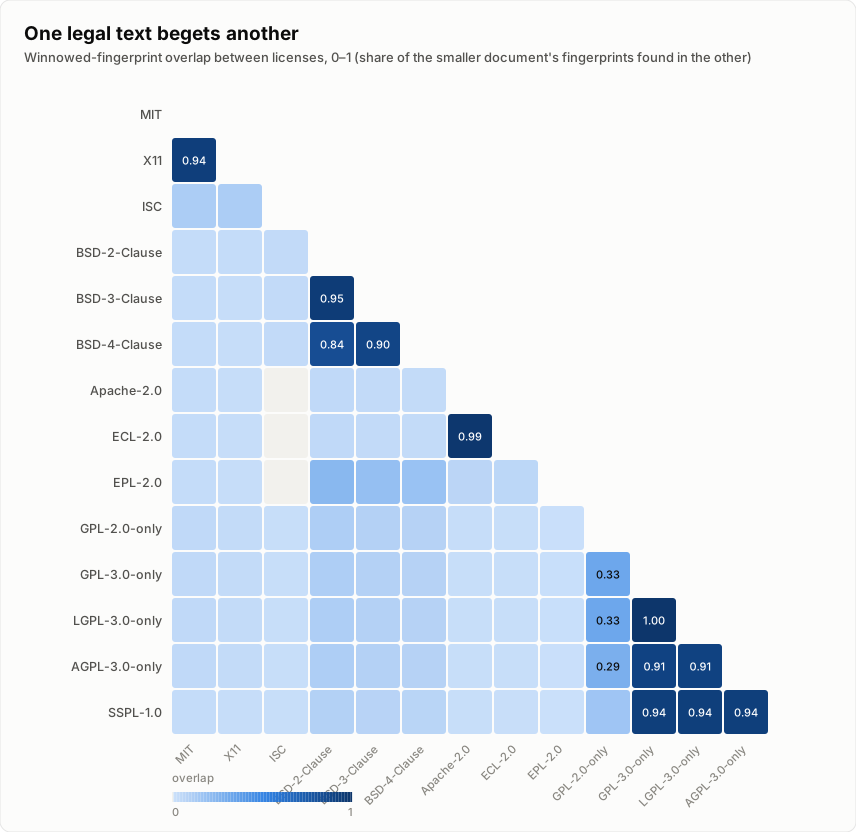
The families emerge from text alone: MIT and X11 at 0.94; the BSD block; ECL-2.0 — an Apache-2.0 derivative by design — at 0.99 with its parent; and the copyleft clade, where LGPL-3.0 contains GPL-3.0 outright (1.00) and SSPL-1.0, drafted from the AGPL, overlaps it at 0.94.
Terms of service show the same inheritance patterns across companies:
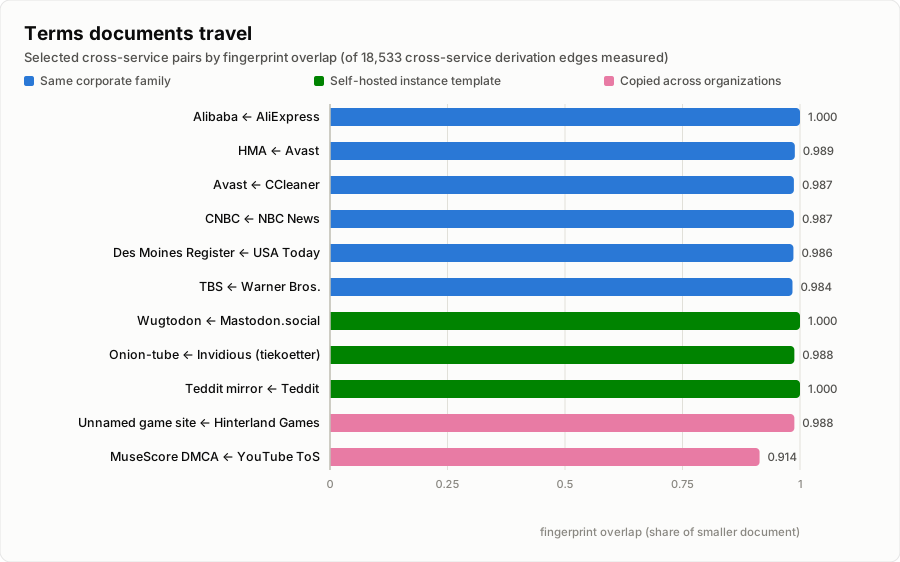
Three modes of descent recur: corporate families sharing one legal template (CNBC ← NBC News at 0.987; Avast ← CCleaner, products of an acquisition, at 0.987), self-hosted software instances shipping template policies verbatim (Invidious, Mastodon, Teddit — 0.98 to 1.00), and outright copying across organizations (MuseScore’s DMCA policy shares 91% of its fingerprints with YouTube’s 2018 terms).
Interrogating the tree: on-prem SLM embedding for semantic search
A family tree of 125,295 clauses is only useful if you can ask it questions. The same embedding space that measures kinship powers plain-English search: type the question the way you would say it aloud — “can they close my account without warning?” — and the best-matching clause returns, matched by meaning rather than keywords. Measured end to end over sixteen real questions: a median of 119 milliseconds per search across the full corpus, as low as 86.
The stack is deliberately on-premises: the embedding model runs on owned hardware, the vectors live in the same database as the fingerprints, and a query costs nothing marginal. That matters twice for this work: the text never leaves the building, and “score every clause of every revision of twenty companies’ terms” is an overnight batch rather than a billing event. Every other measurement in this series — the coverage audit, the clause timeline, the genealogy itself — runs on this same substrate and inherits its speed and its cost of zero.
So where is Eve?
There is no single EULA Eve — no one ancestral agreement every terms-of-service descends from. But the search does find something older than any family: look again at the kinship matrix. The faint blue covering nearly every cell is real signal, not noise — almost every license measured shares the same warranty-disclaimer and limitation-of-liability boilerplate, the ALL-CAPS block that has been copied between legal documents since before most of these licenses existed. It is the closest thing fine print has to mitochondrial DNA: not the oldest document, but the oldest inherited material, carried by essentially every descendant.
The ancestry can be pushed further back. The corpus’s deferred longitudinal asset — 1.07 million dated policy snapshots reaching to 1997 — and URL-succession tracking through the Wayback Machine extend the record decades earlier than any current document. The hunt for Eve is a horizon, and the instruments for the expedition — hashes, fingerprints, embeddings, dated descent — are the orientation this article set out to give.