· 3 min read
Inside cintel: Market Scope
The Market Scope module of cintel's luxury-resale deployment: the segment table behind the dashboard's market tiles — sizes, growth rates, and named sources for each segment of the secondhand luxury trade. Read from the running system.
cintel is RRECKTEK’s competitive-intelligence platform. Inside cintel: Competitive Intelligence for the Luxury Resale Market walked the deployment’s main views and listed the remaining modules in the workspace. This page covers one of them: Market Scope — the segment table behind the dashboard’s market tiles. Every figure below is read from the running system.
The segment table
The segments endpoint returns eleven rows: ten market segments plus one whole-market total. Each row carries a label, a market size in USD, a CAGR, a description, and the named reports the figures were taken from. The total row puts worldwide secondhand personal luxury at $48B, growing 12.0% — Bain & Co. with Altagamma estimated the second-hand luxury market at approximately EUR 43–45 billion in 2023, growing faster than primary luxury.
Segments by brand tier
Five segments cut the market by what the bag is:
- Accessible Luxury (Louis Vuitton / Gucci / Prada / Dior / Saint Laurent, roughly $1.5K–$5K new) — $12.4B, 14.2% CAGR. The largest-volume tier; LV is consistently the most-listed and most-searched brand in resale-platform trend reports.
- Contemporary / Premium (Coach, Burberry, Mulberry, Loewe, Celine, Bottega Veneta) — $6.9B, 16.8%. High-volume entry point into secondhand luxury, driven by Gen-Z and millennial circular-fashion demand.
- Ultra-Luxury (Hermès / Chanel investment-grade) — $5.8B, 11.5%. Dominated by Birkin/Kelly and the Chanel Classic Flap, which hold or appreciate on the secondary market.
- Vintage / Archival (Y2K, discontinued, collector) — $3.1B, 13.4%. Vintage Chanel, Fendi Baguette, Dior Saddle, Gucci Jackie — scarcity and provenance drive pricing rather than condition alone.
- Investment-Grade Hermès (Birkin / Kelly) — $1.8B, 12.7%. The narrowest, highest-value niche: bags traded as alternative assets, ranked by Knight Frank’s Luxury Investment Index 2024 among the top long-run performers.
Segments by channel
Five segments cut the same market by where it trades:
- Online Luxury Resale Platforms (The RealReal, Vestiaire Collective, Rebag, Fashionphile, 1stDibs) — $30B, 11.3%. Managed marketplaces handling authentication and consignment.
- Peer-to-Peer Resale (Poshmark, Depop, Grailed, Whatnot) — $9.5B, 18.5%. Consumer-to-consumer with lighter-touch authentication; the fastest-growing row in the table.
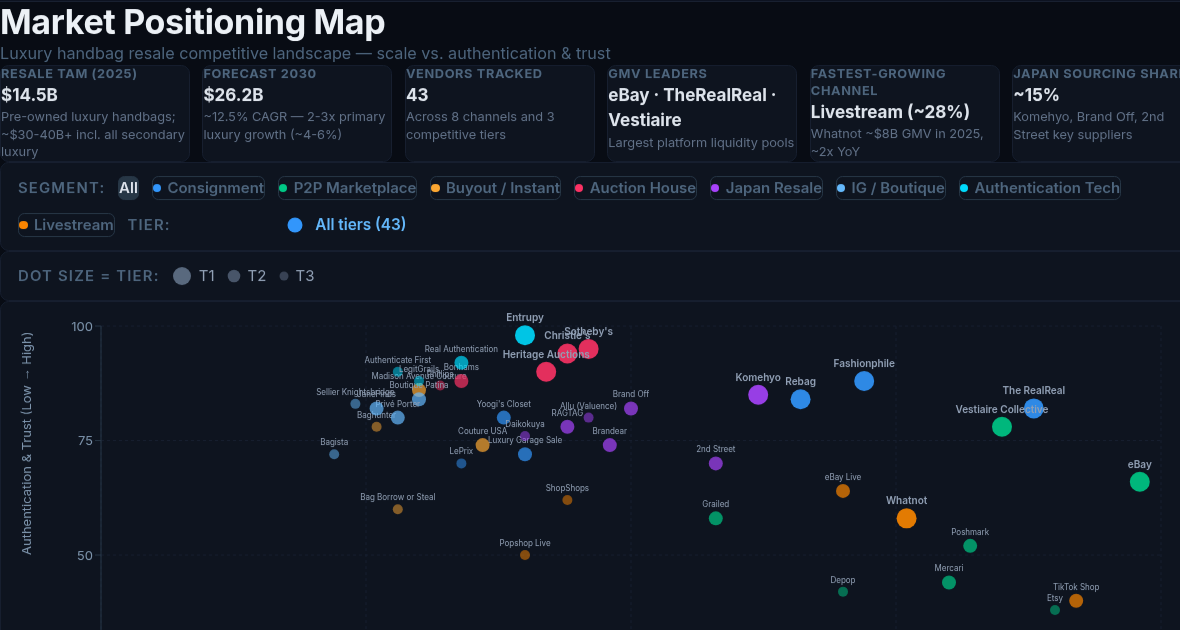
- Japan / APAC Pre-Owned Luxury — $7.2B, 9.8%. Anchored by Komehyo, 2nd Street, RAGTAG, Daikokuya, Brand Off, and Eco Ring, plus the B2B auction houses AUCNET and STAR BUYERS — the sourcing ground the main article’s positioning map flags at ~15% share.
- Luxury Authentication Services — $2.4B, 17.2%. Third-party authentication (Entrupy at ~99.1% claimed accuracy, Real Authentication, platform-internal teams), increasingly mandated by marketplaces.
- Auction-House Handbags (Christie’s, Sotheby’s, Heritage, Bonhams) — $0.6B, 10.5%. Dedicated handbag departments; record Birkins have sold for $300K–$500K+ at auction.
The two cuts overlap by design — an accessible-luxury bag sold on a P2P marketplace sits in one brand-tier row and one channel row — so segment sizes sum across each cut, not across the table.
Sourcing
Every row names its sources: Bain–Altagamma, ThredUp/GlobalData, Grand View Research, Knight Frank, Vestiaire Collective and The RealReal’s own resale reports, Reuse Business Journal (Japan), Komehyo IR, and the auction houses’ published results. The figures on the dashboard tiles resolve to these rows.