· 10 min read
Spontaneous Thought Generation using Daydreamer Agent: Understanding Paradoxes
Daydreamer generates associations without being prompted. Given a lexical model of English — WordNet, VerbNet, SentiWordNet, and the NRC Emotion Lexicon — it draws links between ideas, uses the oppositions among them as a signal, and uncovers the concepts that unify them: concepts its input never named.
Daydreamer draws links between ideas and uses their oppositions as a signal to uncover the concepts that unify them. Open the interactive visualizer to overlay the six paradox families and compare their shapes.
What Daydreamer is
Daydreamer is a cognitive agent derived from Erik Mueller’s 1980s model of directed reverie — a computational account of the associative thought a mind produces when it is not solving an assigned problem. It is structurally unlike a request-response system. It is not posed a question and does not return an answer. Given a scenario, it produces a sequence of associations, emotional responses, and goals, and reports the trajectory. The implementation runs Mueller’s core in Steel Bank Common Lisp within a container and exposes it over an HTTP interface.
An interactive comparison of the paradox families discussed here is available in the Paradox Explorer.
The core operates over eight affect categories — joy, sadness, anger, fear, surprise, disgust, anticipation, and trust — which are Robert Plutchik’s eight primary emotions. Processing proceeds in fixed stages: parse the scenario, generate emotional responses, activate related memories, form goals, and compose a narrative from the result. The purpose is not to answer but to discover: to produce concepts and relations that were not present in the input and were not requested.
In its original form the agent had negligible access to lexical structure. Its parser recognized sixteen literal words; its memory compared two scenarios by counting shared tokens; each emotion produced one fixed goal. The associations it generated were therefore largely undetermined by meaning. The work described here supplies the missing structure and adds a procedure that uses undirected traversal of that structure to surface concepts.
The lexical substrate
The enrichment is computed in a preprocessing layer, where the linguistic resources are available, and passed to the Lisp core as a structured scenario. Four resources contribute, each with a distinct function.
- The NRC Emotion Lexicon (Mohammad and Turney) associates approximately 14,000 words with Plutchik’s eight emotions. Because its categories coincide with the agent’s, it performs emotion classification directly.
- WordNet is a network of word senses connected by hypernym (is-a), meronym (part-of), and antonym relations. Associative thought is traversal of such a network; WordNet supplies one of adequate coverage.
- SentiWordNet assigns positive and negative weights to word senses, providing a graded intensity for each classified emotion.
- VerbNet, the computational form of Beth Levin’s verb classes, encodes the argument structure of psychological verbs — whether the experiencer is the subject (I fear X) or the object (X frightens me). This locates the stimulus of an emotion within a sentence, allowing a goal to reference the stimulus rather than a constant.
The resources are complementary rather than redundant: classification, association, intensity, and argument structure are independent properties. They are also cross-indexed — VerbNet members carry WordNet sense keys — so composition across them requires lookup, not inference.
Three operators over the network
The generative behavior consists of three traversals of the WordNet graph. The first proposes a relation, the second identifies a tension, and the third resolves the tension into a concept.
- Drift proposes a relation. From a concept, ascend one hypernym link to a superordinate category, then descend to a sibling under it. The result is a candidate relation between two concepts the input did not connect.
- Opposition marks a tension. WordNet records antonyms explicitly. When a proposed relation joins a term to its opposite, it asserts a proposition and its negation at once — the formal shape of a paradox. Opposition is not the goal; it is the signal that a unifying concept may exist.
- The lowest common hypernym uncovers the concept. Ascending from both poles of the opposition until they share a category identifies a superordinate that subsumes both. That superordinate is a concept the input did not name, surfaced by the contradiction that pointed to it. Where no common hypernym exists, no concept is invented; the opposition is reported as irreducible.
The paradox, in other words, is instrumental. It is the detector that tells the agent where in the network a concept worth naming is likely to be found.
One scenario, end to end
The following is a single scenario processed by the deployed agent, reported in full. The input was:
I felt joy and sorrow as the old certainty gave way to doubt.
Emotion classification. The lexicon and SentiWordNet assigned the following, with intensity on [0, 1], the trigger word, the extracted stimulus, and the VerbNet class where the trigger is a verb:
| Emotion | Intensity | Trigger | Stimulus | VerbNet class |
|---|---|---|---|---|
| joy | 0.60 | joy | sorrow | — |
| sadness / fear | 0.84 | sorrow | old | marvel-31.3 |
| sadness / fear / trust | 0.64 | doubt | — | conjecture-29.5 |
Oppositions detected. Antonym detection over the salient concepts returned five pairs, three with a lowest common hypernym and two without:
| Pole A | Pole B | Concept uncovered (lowest common hypernym) |
|---|---|---|
| joy | sorrow | feeling |
| certainty | uncertainty | cognitive state |
| doubt | certainty | cognitive state |
| give | take | (none — irreducible) |
| give | starve | (none — irreducible) |
Output. From the oppositions above the agent produced, verbatim:
Paradox: it is at once joy and sorrow. Insight: joy and sorrow are reconciled under feeling; each is a mode of feeling.
Paradox: it is at once certainty and uncertainty. Insight: certainty and uncertainty are reconciled under cognitive state; each is a mode of cognitive state.
Paradox: it is at once give and take. Insight: give and take share no common ground; the paradox stands.
The concepts uncovered — feeling, cognitive state — appear nowhere in the input. They are not retrieved associations; they are the result of ascending the hypernym graph until the opposed poles converge, and they land on defensible superordinates: an affective category for an affective opposition, an epistemic category for an epistemic one. The same procedure applied to other inputs surfaces ending over victory and defeat, financial condition over wealth and poverty, speech act over question and answer. In each the discovered concept is more abstract than either input term and is licensed by the graph rather than asserted.
The give/take pair has no common hypernym in WordNet, and the agent reports the opposition as standing rather than supplying a category. Discovery and its failure are produced by one procedure, and the failure is not suppressed — which is what separates the mechanism from retrieval of pre-written answers.
Two limitations are visible in the same run and are stated rather than hidden: the stimulus extraction is heuristic (old is attached to sorrow by proximity, not by parse), and the give/starve antonym is an artifact of WordNet’s antonym listing for give. Both are properties of the current enrichment layer.
The space of paradoxes
The oppositions the agent uses are not uniform; paradoxes fall into families, and the family determines how readily a unifying concept can be found. A paradox can be placed on two independent axes. The first is Quine’s: whether it is veridical (an unexpected truth), falsidical (a false conclusion from a broken step), or an antinomy (a genuine contradiction that implicates its framework). The second is the mechanism generating the tension — self-reference, vagueness, infinity, aggregation, opposition. Each family has a characteristic profile across those mechanisms; the figure below plots the ten families as radar charts on six attributes. It is a live, interactive page.
▶ Open the interactive Paradox Explorer — select, overlay & imagine paradoxes live →
Open the taxonomy in its own page → · Explore and overlay paradoxes interactively → (Ex Nihilo, Veritas)
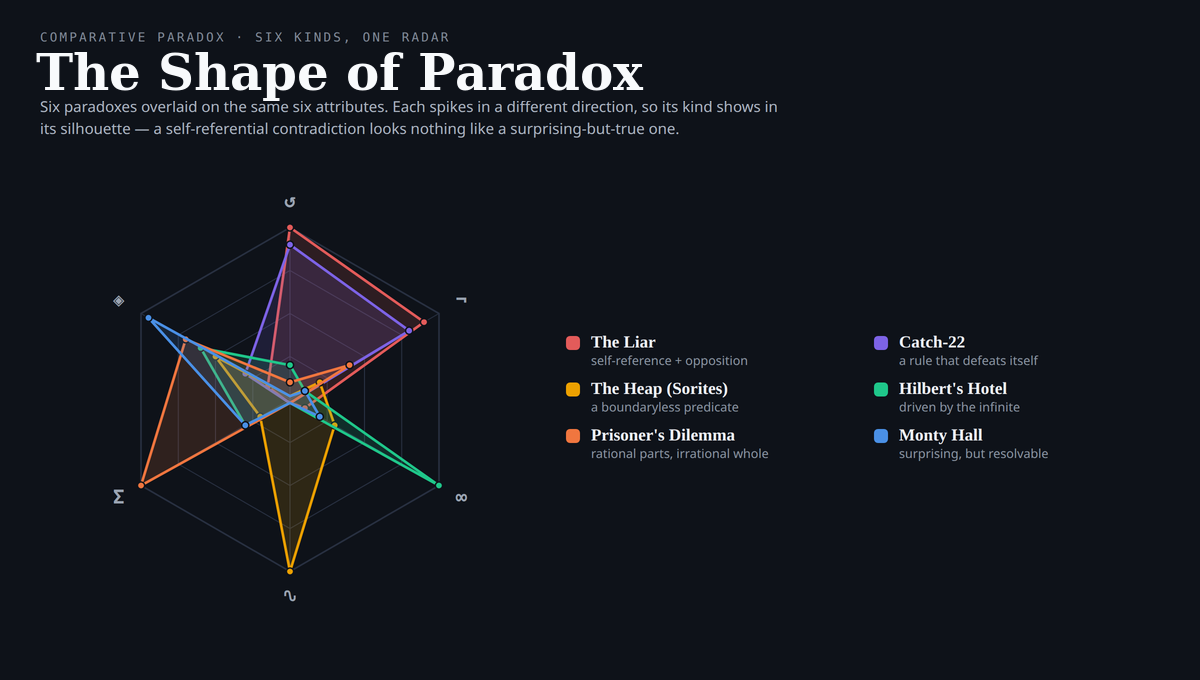
The attributes on those axes are the properties the enrichment layer can measure: opposition from antonymy, aggregation from meronymy, resolvability from the length of the hypernym climb. The taxonomy therefore doubles as an evaluation space. A concept the agent uncovers is worth retaining to the degree that the underlying claim is disprovable — concrete and non-self-referential, so a fact or proof could bear on it — and important — a link between distant ideas rather than near-synonyms. Discoveries low on both are discarded; the pairing of the two criteria separates a genuine concept from an artifact of free association.
Spontaneous discovery
The behavior above satisfies three properties worth stating precisely.
It is spontaneous in that the traversals are not directed by the input or by an external prompt. The scenario supplies concepts; it does not specify which relations to draw among them or which superordinate to seek. The concepts are found by traversing a fixed network without a target, which is the operational sense in which the process is undirected.
It is generative in the constrained-recombination sense: the operators combine existing senses into results that are novel — absent from the input and from any stored list — but not arbitrary, because each step is licensed by an explicit graph relation. Novelty bounded by structure is the standard characterization of combinatorial creativity, and it is what distinguishes discovery from noise.
And it adds content. Feeling is not a paraphrase of I felt joy and sorrow; it is a concept the sentence did not contain, derived and defensible. The agent leaves its input holding more than it started with.
The system does not understand the concepts it uncovers, and no such claim is made here. The claim is narrower and demonstrable: an agent that traverses a lexical model of the language without a goal will encounter contradictions, and where the structure permits it will resolve each contradiction into a more general concept the input never stated — with a filter for disprovability and importance selecting the discoveries that merit attention. The paradox is the instrument; the concept it points to is the result.
Related
- Hivemind: working with multi-agent memory — the governed memory this agent registers with, and where the paradox taxonomy is stored for other agents to read.
- Why pharmacovigilance benefits from graph use — another problem answered by traversing a terminology hierarchy, there over drug and reaction vocabularies rather than WordNet.
- Building an AI strategy — the wider view these agents are built to serve.
References
The Daydreamer architecture (Mueller). The model here descends from Erik T. Mueller’s DAYDREAMER, developed at UCLA between 1983 and 1988.
- Mueller, E. T. (1990). Daydreaming in Humans and Machines: A Computer Model of the Stream of Thought. Norwood, NJ: Ablex. — the primary source; Mueller’s UCLA dissertation work in book form.
- Mueller, E. T., & Dyer, M. G. (1985). Towards a computational theory of human daydreaming. Proceedings of the Seventh Annual Conference of the Cognitive Science Society. — web.cs.ucla.edu/~dyer/Papers/CogSci85Daydream.html
- Mueller, E. T. DAYDREAMER — program description and source, CMU Artificial Intelligence Repository. — cs.cmu.edu/Groups/AI/new/daydreamer
Lexical resources.
- Fellbaum, C. (Ed.) (1998). WordNet: An Electronic Lexical Database. Cambridge, MA: MIT Press. — wordnet.princeton.edu
- Levin, B. (1993). English Verb Classes and Alternations: A Preliminary Investigation. Chicago: University of Chicago Press.
- Schuler, K. K. (2005). VerbNet: A Broad-Coverage, Comprehensive Verb Lexicon. Ph.D. dissertation, University of Pennsylvania. — verbs.colorado.edu/verbnet
- Mohammad, S. M., & Turney, P. D. (2013). Crowdsourcing a Word–Emotion Association Lexicon. Computational Intelligence, 29(3), 436–465. — the NRC Emotion Lexicon (EmoLex).
- Baccianella, S., Esuli, A., & Sebastiani, F. (2010). SentiWordNet 3.0: An Enhanced Lexical Resource for Sentiment Analysis and Opinion Mining. Proceedings of LREC 2010.
Emotion and paradox.
- Plutchik, R. (1980). A general psychoevolutionary theory of emotion. In R. Plutchik & H. Kellerman (Eds.), Emotion: Theory, Research, and Experience, Vol. 1. Academic Press. — the eight primary emotions.
- Quine, W. V. O. (1966). The ways of paradox. In The Ways of Paradox and Other Essays. New York: Random House. — the veridical / falsidical / antinomy distinction.